

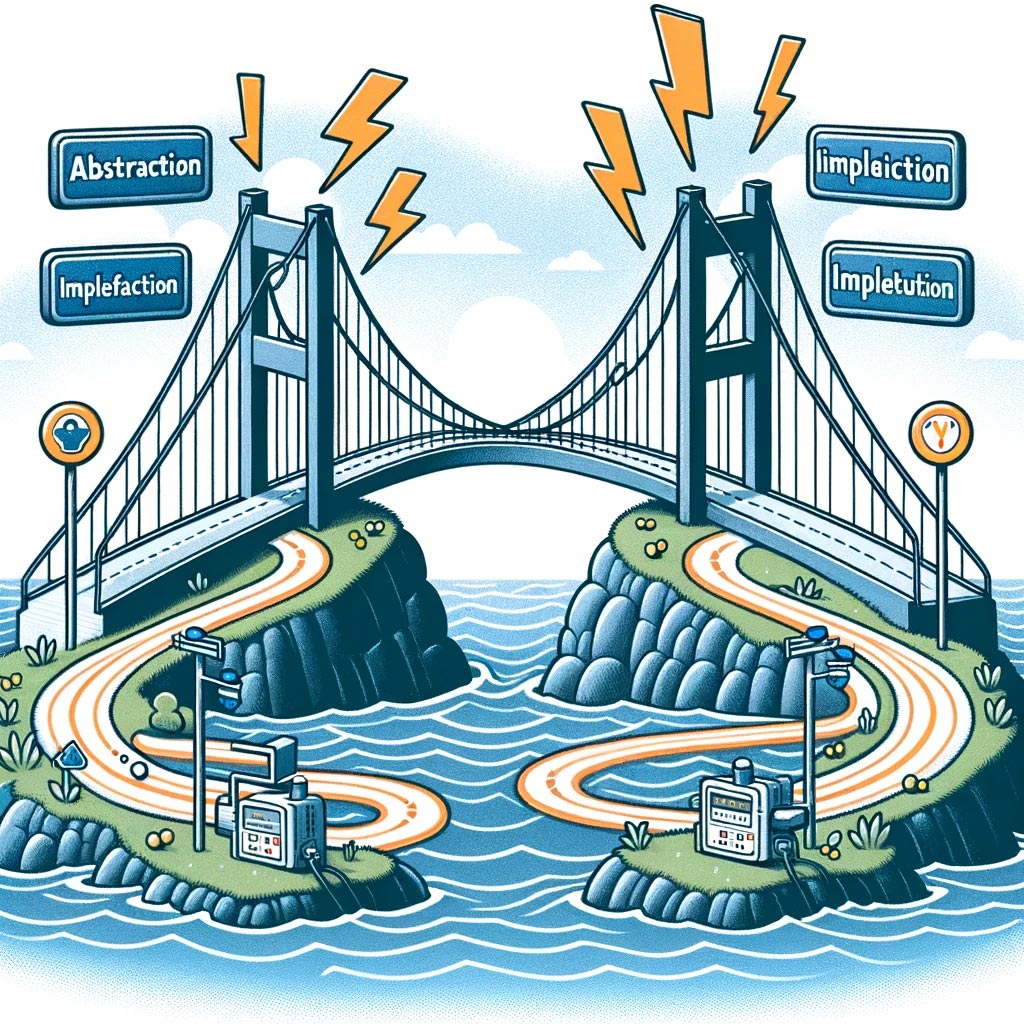
What is the Bridge pattern?
The Bridge pattern is a design pattern for software that serves to decouple an abstraction from your implementation so that both software components can be changed independently of each other without influencing each other.
It is one of the structural design patterns and is useful in situations where you have multiple variants of a single component and want to avoid creating a subclass for each variant.
1. classification of the bridge concept:
The bridge pattern, also known as the bridge design pattern, is a structural design pattern. Structural design patterns deal with how classes and objects can be put together to form larger structures. The main goal of the bridge pattern is to separate abstraction and implementation so that they can be developed and modified independently of each other.
2. reference to the software architecture:
Software architecture focuses on the design of system structures and components. The bridge pattern can be seen as an instrument in this architecture that enables flexible structuring. It helps:
- Abstraction: The pattern allows developers to separate the high-level logic of a system (the abstraction) from the actual implementation details.
- Reusability: Since abstraction and implementation are separate from each other, both can be reused and combined independently.
- Extensibility: The pattern makes it easier to add new implementations or abstractions without changing existing code.
These aspects are central to software architecture, as they ensure that a system is able to adapt to changing requirements without requiring extensive revisions.
3. relevance for software development:
Software development revolves around the creation of programs and applications that solve specific problems or requirements. To do this effectively:
- Flexibility: Software often has to react to different environments or requirements. The bridge pattern offers this flexibility by allowing implementations to be easily exchanged or extended.
- Maintainability: Requirements can change over time. The separation of abstraction and implementation makes it easier to maintain and update the code without affecting the overall system.
- Reduction of code duplication: Instead of writing separate code for each combination of abstraction and implementation, the bridge pattern enables a clean separation and prevents redundant code fragments.
One bridge for two software components
The bridge design pattern consists of two main parts: an abstraction and an implementation. The abstraction defines the interface with which the client interacts, while the implementation provides the concrete realization of the abstraction. The two parts are then connected to each other via a bridge object.

Bridge Design Pattern – Bridge for two incompatible technologies
In other words, the bridge pattern in software development offers a way to separate the interface from your implementation. This separation enables greater flexibility and makes it easier to change and expand the system.
Practical example for the bridge pattern
For example, if you have a GUI component that can be displayed on multiple platforms, such as Windows and MacOS, you can use the bridge pattern to separate the platform-specific code from the GUI code. This way you can easily add support for new platforms without changing the existing code.
The Bridge pattern is therefore a useful tool for creating flexible, modular and easy-to-maintain systems. It promotes good software design practices such as abstraction, encapsulation and separation of concerns and can help your code better adapt to changing requirements and future code enhancements.

Code example for Bridge Design Pattern
Bridge pattern code example in JavaScript
Here you can see a code example for the application of the Bridge design pattern to a GUI component that can be displayed on both Windows and MacOS:
In thisJavaScript code example, we have an abstraction called GUIComponent, which represents a generic GUI component. The GUIComponent constructor takes a platform object that is used to render the component on the corresponding platform.
We also have two implementations called WindowsGUI and MacOSGUI, which represent the platform-specific code for rendering the GUI component. Both classes implement a render method that outputs the corresponding message for the respective platform.
In the usage section, we create two instances of GUIComponent, one for Windows and one for MacOS, and pass the appropriate platform object for each. We then call the render method for each GUIComponent object, which uses the correct platform object to render the component on the appropriate platform.
This practical example shows how we can use the bridge pattern to separate the abstraction of the GUI component from its platform-specific implementation. This will allow us to easily add support for new platforms in the future without having to change the existing code for the GUI component.
What properties do bridge patterns have?
The bridge pattern is a structural design pattern that serves to separate the abstraction from its implementation. This separation ensures greater flexibility and expandability and decouples the abstraction from the implementation.
The bridge pattern consists of two parts: the abstraction and the implementation. The abstraction defines the interface with which the client interacts, while the implementation provides the concrete realization of the abstraction. The two parts are then connected via a bridge object, which is responsible for forwarding requests from the abstraction to the implementation.
Advantages
One of the main advantages of the bridge pattern is that the abstraction and the implementation can develop independently of each other. This is particularly useful in situations where there are multiple variations of a single component, such as a GUI component that needs to run on different platforms, or a database driver that needs to work with multiple database systems. Instead of creating a subclass for each variant, we can use the bridge pattern to separate the common functionality from the platform-specific code.
Another advantage of the bridge pattern is that it promotes good software design practices such as abstraction, encapsulation and separation of concerns. By separating the abstraction from the implementation, we can keep the code base modular and easier to maintain. We can also add new functions and change the code without destroying existing functions.
Disadvantages
However, the bridge pattern also has some disadvantages. The increased flexibility and extensibility it offers comes at the cost of increased complexity. The bridge object can introduce an additional indirect layer that can affect performance. In addition, the Bridge pattern is not suitable for all situations and may be superfluous for simpler applications.
To summarize, the bridge pattern is a useful design pattern to separate the abstraction from the implementation and thus provide more flexibility and extensibility. While it can lead to more complexity, it also encourages good software design practices and can make it easier to maintain and change the code base.
Advantages of the bridge design pattern
Separation of concerns
The bridge pattern separates the abstraction from the implementation, which enables a better separationof concerns and a more modular code.
Expandability
With the bridge pattern, new abstractions and implementations can be added independently of each other, making the code base expandable and easier to maintain.
Flexible
The bridge pattern offers greater flexibility, as the abstraction and implementation can develop independently of each other. This makes it easier to add new functions and change the code without affecting the existing functionality.
Encapsulation
The bridge pattern promotes encapsulation by hiding the implementation details from the client and providing a simpler interface for abstraction.
Platform independence
The bridge pattern is particularly useful for creating software that needs to work on multiple platforms, such as GUI components that need to run on different operating systems.
When the bridge pattern is not suitable for use:
Overengineering
The bridge pattern can lead to unnecessary complexity in simple applications, making it difficult to understand and maintain the code base.
Limited variations
If there are only a limited number of variations of a component, creating a bridge object for each variation may not be necessary and can lead to unnecessary complexity.
Effects on performance
By introducing a bridge object, an additional indirect layer can be added, which can have an impact on performance, especially for performance-sensitive applications.
Close coupling
If the abstraction and the implementation are closely coupled, it may not be possible to separate them using the bridge pattern without significant refactoring.
Lack of clear separation
If there is no clear separation between the abstraction and the implementation, it can be difficult to apply the bridge pattern effectively.
Summary
Overall, the bridge pattern in software development ensures that programs are modular, maintainable and flexible, which is crucial in the rapidly changing world of technology.

Bridge Pattern – flexible – modular – maintainable
The bridge pattern, also known as the bridge design pattern, is a structural design pattern in software development that enables the separation of abstraction and implementation of a system. This means that both aspects can be developed and modified independently of each other. The main goal is to create a flexibility that facilitates the addition of new implementations or abstractions without changing existing code. In software architecture, it offers the advantages of reusability, expandability and a clear separation of concerns. While it offers many advantages, including promoting good software design practices, increased modularity and reduced risk of code duplication, it also has disadvantages such as potentially increased complexity and possible performance degradation due to additional layers of indirection.
Conclusion and evaluation:
The Bridge pattern is a powerful tool in a software developer’s arsenal. It promotes clean, modularized and maintainable code and makes it easier to adapt to changing requirements. It is particularly valuable in situations where a system requires different implementations or abstractions that can vary independently of each other.
However, it is important to use the pattern carefully. In simpler applications or situations with limited variations, it can lead to over-engineering and make things unnecessarily complicated. As with most design patterns, it is important to consider the context and specific requirements of a project before deciding on its application.
Overall, in the right contexts, the Bridge pattern can provide significant value and should be considered an important technique in software development.