
What is a conditional expression?
A conditional expression is used in programming as a logical condition to perform various calculations or actions.
Boolean logic – elementary in programming
A conditional statement is executed depending on whether a Boolean condition defined by the programmer is evaluated as true (TRUE) OR false (FALSE).

Conditional statement / boolean expression – Rock the Prototype
How does a conditional expression work?
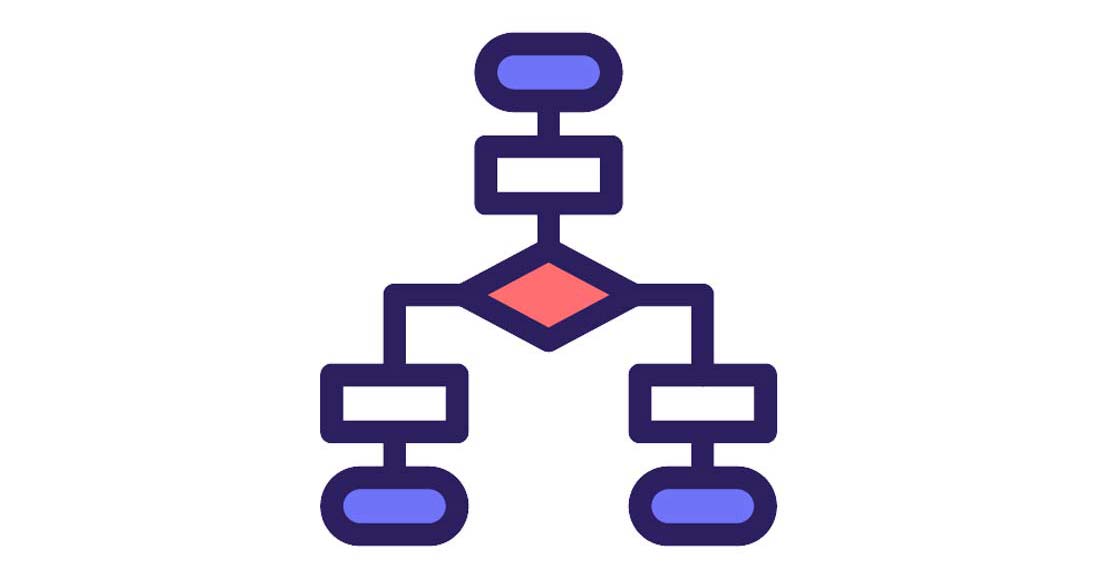
The if-then-else construct is common in many programming languages. Although the syntax is quite different from programming language to programming language, the basic structure – here in pseudocode – is as follows:
If (boolean condition) Then

-- do some stuff

Else

-- do other stuff

End If
If an interpreter finds an If condition, i.e. checks an If query for its truth content, the interpreter expects a Boolean condition.
Boolean operations for program conditions
Such a Boolean check is, for example, x > 0. For our program, this means evaluating the condition x greater than zero for its truth content: If “the variable x contains a number that is greater than zero” – THEN the condition is TRUE. If the condition is TRUE, the interpreter enters the Then statement and only executes the statement contained there under this condition. Otherwise, execution continues in the following branch – either in the else block (which is usually optional) or, if there is no else branch, after the end If. Conditional statements occur in almost every program in countless numbers, are encapsulated in functions and can therefore be used as the simplest design pattern can be described as the simplest design pattern.
Conditional expressions and their significance for program control
Conditional expressions are central building blocks for decision logic in programming. They allow a program to execute different sequences depending on whether certain conditions are met. This allows the program to react flexibly and interactively to different inputs or states. Typical applications are validations, calculations and the selection of program paths based on user interactions.
Typical conditional expressions and links
Conditional expressions often contain logical operators such as AND, OR and NOT which enable more complex conditions. For example, an expression such as (x > 0 AND y < 10) can be used to check whether both conditions – x greater than 0 and y less than 10 – are true at the same time. Such links can greatly extend the logic within if-then-else structures, resulting in more dynamic and intelligent programs.
Conditional expressions as part of loop structures
Conditional expressions also play an important role in loops in order to control their execution. In while loops, for example, the loop remains active as long as the condition is true. If the condition becomes FALSE while the loop is running, the interpreter terminates the loop. An example:
This construct makes it possible to perform repeated actions until a certain condition is no longer fulfilled. In practice, conditional expressions in loops are often used in scenarios where user input needs to be checked or processes need to be monitored.
Conditional expressions as part of loop structures
Conditional expressions also play an important role in loops in order to control their execution. In while loops, for example, the loop remains active as long as the condition is true. If the condition becomes FALSE while the loop is running, the interpreter terminates the loop. An example:
while (x > 0):
    # Executes instructions as long as x is greater than 0
    x -= 1
This construct makes it possible to perform repeated actions until a certain condition is no longer fulfilled. In practice, conditional expressions in loops are often used in scenarios where user input needs to be checked or processes need to be monitored.
Rock the Prototype Podcast
The Rock the Prototype Podcast and the Rock the Prototype YouTube channel are the perfect place to go if you want to delve deeper into the world of web development, prototyping and technology.
🎧 Listen on Spotify: 👉 Spotify Podcast: https://bit.ly/41pm8rL
🍎 Enjoy on Apple Podcasts: 👉 https://bit.ly/4aiQf8t
In the podcast, you can expect exciting discussions and valuable insights into current trends, tools and best practices – ideal for staying on the ball and gaining fresh perspectives for your own projects. On the YouTube channel, you’ll find practical tutorials and step-by-step instructions that clearly explain technical concepts and help you get straight into implementation.
Rock the Prototype YouTube Channel
🚀 Rock the Prototype is 👉 Your format for exciting topics such as software development, prototyping, software architecture, cloud, DevOps & much more.
📺 👋 Rock the Prototype YouTube Channel 👈 👀
✅ Software development & prototyping
✅ Learning to program
✅ Understanding software architecture
✅ Agile teamwork
✅ Test prototypes together
THINK PROTOTYPING – PROTOTYPE DESIGN – PROGRAM & GET STARTED – JOIN IN NOW!
Why is it worth checking back regularly?
Both formats complement each other perfectly: in the podcast, you can learn new things in a relaxed way and get inspiring food for thought, while on YouTube you can see what you have learned directly in action and receive valuable tips for practical application.
Whether you’re just starting out in software development or are passionate about prototyping, UX design or IT security. We offer you new technology trends that are really relevant – and with the Rock the Prototype format, you’ll always find relevant content to expand your knowledge and take your skills to the next level!