

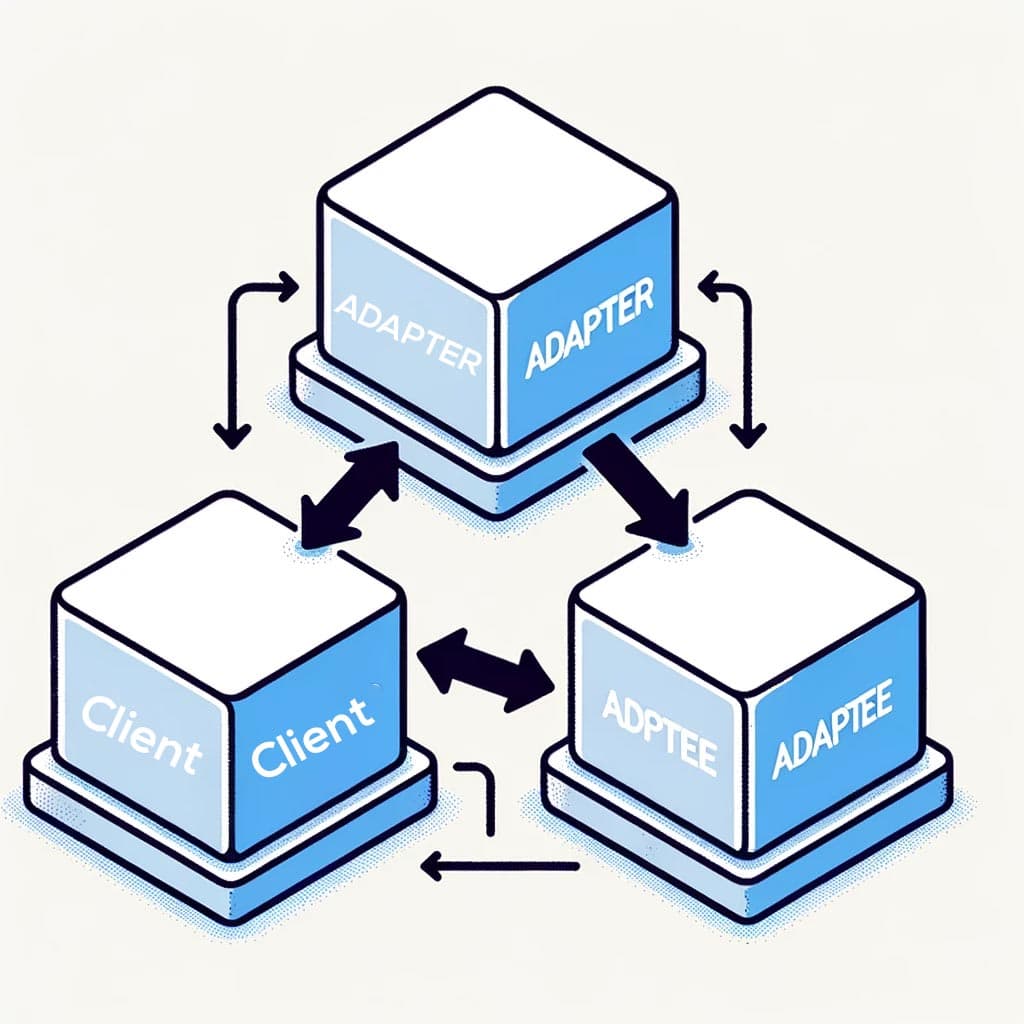
What is an adapter pattern?
The Adapter Pattern 🧩 is a structural design pattern for software that allows objects with incompatible interfaces to work together. It converts the interface of one class into another interface so that this API then fulfills the functional requirements and is easily maintainable without changing the source code of the original class.🔄💻

Adapter Pattern – Design Pattern for Software Architecture
⚙️ The capabilities of this design pattern come into play when you need to adapt an API that is outside the scope of the software you are working on. So it helps you by bridging the gap between incompatible interfaces and making your development smoother and more efficient. 🚀🔗
Do you want to know how the Adapter Pattern works?
🔎 Curious about how this coding pattern works? Let’s dive in! 🤿 The main idea behind this design pattern is to create a class – the adapter – that sits between two incompatible interfaces and translates requests from one interface to the other. 🔄🔌
💡 The adapter takes an object that has the desired interface but cannot be used directly by the client and adapts it to the interface that the client expects. It is something like a language translator for your code, ensuring effective communication between different components. 🗣️💪

Adapter Design Pattern – Translator – Adapter Pattern
🌟 So the next time you encounter incompatible interfaces, just think of the Adapter Pattern as your trusted ally! It allows you to seamlessly integrate different components and maintain a robust and flexible code base. 🌐🔌
Diese Eigenschaften des Adapter Pattern sind immer dann sehr nützlich, wenn eine anzupassende API nicht im Einflussbereich der zu ändernder Software liegt.
How does the Adapter Pattern work?
The main idea behind the adapter design pattern is to create a class – the adapter – that sits between two incompatible interfaces and translates requests from one interface to the other.
The adapter takes an object that has the desired interface but cannot be used directly by the client and adapts it to the interface that the client expects.
Components of the adapter pattern
1. Target
This is the interface that the client expects to work with. The client interacts with this interface to get the desired results.
2. Adaptee
This is the existing class that needs to be adapted to work with the target interface. It has an incompatible interface with the client.
3. Adapter
This is the class that adapts the adaptee to work with the target interface. It implements the target interface and communicates with the adaptee to perform the desired actions.
Application example illustrating the adapter design pattern:
Suppose we have a client that uses a third-party library to print text to the console. The library has a method called printText that takes a string as an argument and prints it to the console. However, the client wants to use a different library that has a method called displayText to achieve the same result.
The displayText method also takes a string as an argument and outputs it to the console, but it has a different method signature than the printText method.
To solve this problem, we can create an adapter class that implements the Target interface (i.e. displayText) and communicates with the adaptee (i.e. the third-party library) to perform the desired action,
Basic principle adapter class
The adapter class would have a method called displayText that takes a string as an argument, calls the third-party library’s printText method with the same argument, and achieves the desired result.
Consequently, the adapter pattern allows objects with incompatible interfaces to work together by creating an adapter class that translates requests from one interface to another.
It thus provides a way to reuse existing code without modifying it, making it a powerful and flexible design pattern.

Adpater-Pattern Concept – You already realize that adapters are often not easy…
Code example for the implementation of the adapter pattern
Our practical code shows you how this design pattern works and is basically structured. So you can easily understand how this coding pattern works and modify it for your purpose.
Code example in JavaScript
Here is an easy-to-understand example of implementing the adapter design pattern in JavaScript:
In this Java Script code sample, we have an Adaptee class called ThirdPartyLibrary that has a printText method that prints text to the console. We want to use this class with a target interface called TextPrinter, which has a method displayText that also outputs text to the console.
To allow these two classes to work together, we create an adapter class called TextPrinterAdapter that implements the TextPrinter interface and receives an instance of the ThirdPartyLibrary class as a constructor parameter. In the displayText method of the adapter, we call the printText method of the ThirdPartyLibrary instance to achieve the same result.
Finally, in the client code, we create an instance of the ThirdPartyLibrary class and an instance of the TextPrinterAdapter class and pass the ThirdPartyLibrary instance as a parameter to the constructor of the adapter.
Then we call the displayText method of the adapter with our text, and it prints the text to the console using the printText method of the ThirdPartyLibrary instance.
Summary
In software development, there is often the problem that two systems or classes cannot interact directly with each other because they use different interfaces or interfaces. This is where a particular design pattern comes into play, serving as a bridge between these incompatible systems. This pattern is known as the “Adapter Pattern“.
Imagine you have an electronic device that you want to use in another country. Unfortunately, the plug of the device does not fit into the socket of the country. Here you need a socket adapter to fix the problem. This real-world example perfectly illustrates how the corresponding design pattern works in software development. It allows two different systems to interoperate by modifying the interface of one system so that it can be understood by another without requiring changes to the original system.

This way you are guaranteed to remember what the adapter pattern is. Real Adapter – Socket Adapter – Rock the Prototype – Learn to program.
The central actor in this pattern is the so-called adapter. This acts as an intermediary between the client and the service that the client wants to use but cannot call directly due to interface differences. The adapter translates the client’s requests into a format that the service can understand, enabling interaction.
2 Approaches to implementing this design pattern
There are two common approaches to implementing this pattern: the class adapter and the object adapter. The class adapter uses multiple inheritance to inherit both the client and service interfaces. However, this approach has its limitations, especially in languages that do not support multiple inheritance. The object adapter, on the other hand, uses composition and holds a reference to an object of the service. This approach is more flexible and more commonly used.
Code reusability
Another important aspect of this pattern is its impact on code reusability. Often developers face the challenge of reusing existing code in new projects, but encounter compatibility issues. The aforementioned pattern can provide an effective solution here, as it allows existing code to be used in a new context without having to change it.
When this design pattern does not fit…
However, there are situations when the application of the pattern is not ideal. If there are only a few incompatible interfaces and there is little likelihood that more will be added, the implementation of the adapter may seem overly complex. It is always advisable to consider the specific requirements and context of a project before deciding to use a particular design pattern.
In conclusion, we can say that the pattern is a valuable programming technique in the toolbox of any software developer. It promotes software reusability, modularity and extensibility and is a key concept for the development of flexible and maintainable systems. In an ever-changing technology landscape, where the integration of different systems is becoming increasingly important, the adapter principle remains an indispensable tool for developers.