
What is Java?
Java is an object-oriented programming language and is one of the higher programming languages. Java is therefore suitable for object-oriented programming and was introduced on May 23, 1995.
The programming language was developed by the developer of the microcomputer star James Gosling, who is regarded as the forefather of this strict object orientation in the design of the language and at the same time a platform-independent programming language. Java Script is not a Java-based scripting language, but a programming language in its own right.
Properties of Java as a programming language
What is Java suitable for in programming?
Java is very popular as the official language for developing Android apps. It is a general purpose programming language. This programming language is supported by Google and a large active community of developers.
Why is Java so popular with developers?
With Java technologies, software developers are able to write code in the form of classes and objects. Java supports all types of Android programming languages, including web applications, desktop applications, client-server applications and enterprise applications. With its appearance, the then still young programming language emerged as a simpler and safer alternative to C++.
Write once, run anywhere
With this promise, Java has become one of the leading computer languages for developers all over the world. This language is object-oriented and class-based and follows the “WORA” principle:
“write once, run anywhere”
Platform independence
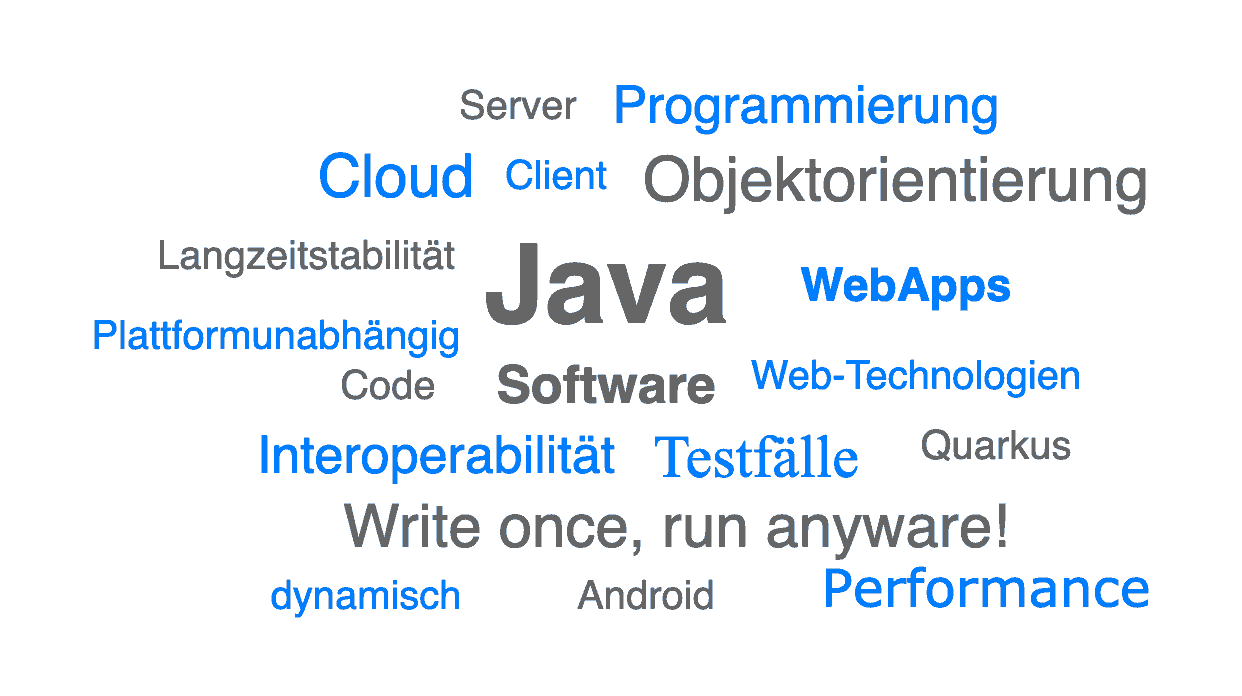
This means that once you have created your Java programs, you can run them anywhere, regardless of the hardware and operating systems. With the spread of Docker containers, this argument has lost some of its weight. Software engineers love Java for its concurrency – many keep comparing it to Python and consider it superior in this respect. The enormous selection of libraries and the consistently good performance also often speak in favor of Java programming in software projects. The community is also huge, which means that Java fans can always rely on broad support. There is a huge ecosystem of countless frameworks, libraries, development tools, documentation and available developers around Java.
Long-term stability
One of the key characteristics of Java programs is their long-term stability. As a rule, code that is around 30 years old still runs on a current JVM.
Cloud as home advantage number 2 – Java migration with little effort
Long-lived Java code is becoming highly relevant with the cloud trend: Existing software projects can be migrated to the cloud with little effort. If software works reliably and without errors, then cloud migration and microservices are a sensible option. Oracle also guarantees the reliable further development of the programming language and Java technologies.
The “Valhalla” project is proof of this and aims to introduce user-defined primitive types (value types), among other things.
High performance
Java also has nothing to hide when it comes to performance: The language is still one of the fastest execution environments and is even widely used in high-frequency trading.
How does Java programming work?
Java programming is based on class-based and object-oriented attributes.
Is Java programming still relevant today?
Even though Java code has been used in processors on a wide range of devices for over a quarter of a century, Java is still one of the modern programming languages. An enormous number of important software projects have specifically chosen Java as their base technology. From NASA to Google, eBay and Twitter, countless companies rely on Java software.
Embedded Systems programming is a home run with Java!
The programming language runs on every conceivable embedded system and, according to Oracle, has over 45 billion active Java Virtual Machines (JVM) worldwide. Such an enormous spread is certainly an important advantage, especially as many functionalities from existing projects can be used. Nevertheless, some developers consider Java to be a product that has its best years behind it. One possible reason for this could be that Java 8 from 2014 is still the standard in many companies.
You should definitely know these Java resources:
There are some very useful resources for Java developers that will make your coding easier and help you improve your code quality:
Java style guide from google
Google’s style guide for Java is a particularly helpful resource
- https://google.github.io/styleguide/javaguide.html
Java framework Quarkus
The Java framework Quarkus allows you a super fast workflow for your Java development!
- https://quarkus.io
Your code can be changed very quickly with this framework, the compilation works automatically and the source code can be tested immediately.
How much demand is there for Java developers?
Java developers are still very much in demand as software developers! On the one hand, this is due to the enormous number of existing software projects based on this code. On the other hand, Java programmers are considered highly experienced programmers because they have basic programming paradigms such as strict object orientation or polymorphism in their blood!
Java in modern software development
Java remains a mainstay in software development, especially in mission-critical applications and modern architectures such as microservices. It combines proven stability with continuous development, enabling developers to keep pace with the latest technological requirements.
Areas of application for Java
Java is not only known for Android apps and server-side applications, but is also used in numerous other areas:
- Enterprise applications: With frameworks such as Spring and Jakarta EE, Java is the preferred choice for enterprise software.
- Cloud-native development: With tools such as Kubernetes, OpenShift and frameworks such as Quarkus and Micronaut, Java is ideally suited for cloud-native applications.
- Big data: Technologies such as Hadoop and Apache Spark are based on Java and support the processing of large amounts of data.
- Internet of Things (IoT): Java runs on many embedded systems that are used for IoT projects.
- Web development: With frameworks such as Vaadin, Play and JavaServer Faces (JSF), Java offers robust solutions for modern web applications.
Recent developments in Java
The continuous development of Java shows that the language is still relevant. Newer versions such as Java 17 (LTS) and Java 20 offer numerous features:
- Pattern matching: Simplified and clearer code structures through pattern recognition.
- Record classes: Simple definition of data objects without boilerplate code.
- Project Loom: Improved thread management and scalability through virtual threads.
- Project Panama: Easier access to native libraries and APIs, allowing Java to penetrate areas close to the system.
Java vs. competing languages
Although languages such as Kotlin, Go or Python are more popular in certain scenarios, Java remains competitive:
- Compared to Kotlin: Kotlin is often seen as a more modern alternative for Android development, but Java remains the dominant language due to its stability and backwards compatibility.
- Compared to Python: While Python scores highly in AI and data science, Java is superior in terms of performance and scalability of large-scale projects.
- In comparison to Go: Go is suitable for simple and high-performance applications, while Java convinces with a rich tool and library landscape.
Best practices in Java development
To exploit the full potential of Java, developers should observe the following best practices:
- Use of modern frameworks: Frameworks such as Spring Boot or Quarkus accelerate development and facilitate integration.
- Optimization of the JVM: Performance and memory management can be improved by fine-tuning the Java Virtual Machine (JVM).
- Unit tests and CI/CD: Tools such as JUnit and Jenkins enable automated tests and an efficient development cycle.
- Security aspects: Regular updates to newer versions and the use of security libraries such as OWASP help to close security gaps.
Java for the next generation of developers
Java is one of the best languages for learning the basics of programming:
- Clearly defined syntax: The strict object orientation and the class-based structure promote a solid understanding of programming.
- Broad community: The Java community offers a wealth of resources, tutorials and open projects for beginners.
- Job prospects: Due to the high demand for Java developers, the language opens up excellent career opportunities.
Java and sustainability
Java can be made sustainable by optimizing its development and operation:
- Efficient use of the JVM: The JVM can save resources through containerization and serverless technologies.
- Green IT: Resource consumption is reduced through energy-efficient programming practices and the use of cloud environments that rely on renewable energy.
Java remains a heavyweight in software development and offers developers the perfect mix of stability, performance and innovation. Thanks to its continuous development and wide range of applications, Java will continue to play a leading role in programming in the future.
Rock the Prototype Podcast
The Rock the Prototype Podcast and the Rock the Prototype YouTube channel are the perfect place to go if you want to delve deeper into the world of web development, prototyping and technology.
🎧 Listen on Spotify: 👉 Spotify Podcast: https://bit.ly/41pm8rL
🍎 Enjoy on Apple Podcasts: 👉 https://bit.ly/4aiQf8t
In the podcast, you can expect exciting discussions and valuable insights into current trends, tools and best practices – ideal for staying on the ball and gaining fresh perspectives for your own projects. On the YouTube channel, you’ll find practical tutorials and step-by-step instructions that clearly explain technical concepts and help you get straight into implementation.
Rock the Prototype YouTube Channel
🚀 Rock the Prototype is 👉 Your format for exciting topics such as software development, prototyping, software architecture, cloud, DevOps & much more.
📺 👋 Rock the Prototype YouTube Channel 👈 👀
✅ Software development & prototyping
✅ Learning to program
✅ Understanding software architecture
✅ Agile teamwork
✅ Test prototypes together
THINK PROTOTYPING – PROTOTYPE DESIGN – PROGRAM & GET STARTED – JOIN IN NOW!
Why is it worth checking back regularly?
Both formats complement each other perfectly: in the podcast, you can learn new things in a relaxed way and get inspiring food for thought, while on YouTube you can see what you have learned directly in action and receive valuable tips for practical application.
Whether you’re just starting out in software development or are passionate about prototyping, UX design or IT security. We offer you new technology trends that are really relevant – and with the Rock the Prototype format, you’ll always find relevant content to expand your knowledge and take your skills to the next level!